One Constant Through Decades of Change
After 54 years as Edina’s city clerk, Margaret Gibson retires following a career that spanned generations of change in city government.
By Echo Menges
EDINA, Mo. — When Margaret Gibson arrived at Edina City Hall in late June 1972, nearly every task performed by the city clerk’s office required paper, carbon copies and a typewriter.
There were no computers. No email. No photocopier.
Payroll checks were typed one at a time. City licenses were prepared individually. Tax records were completed by hand using large books and carbon paper, and council meeting minutes were carefully typed into oversized bound volumes that remain part of the city’s permanent record more than five decades later.
Fifty-four years later, Gibson retired July 1 as Edina’s city clerk, bringing to a close one of the longest tenures in Edina city government.
As city clerk, Gibson’s responsibilities evolved with the changing needs of the community. Throughout her career, she maintained official city records, prepared agendas and meeting minutes, published legal notices, administered elections, processed payroll, collected utility billing, assisted with budgeting and helped ensure residents had access to public records. While technology and procedures changed dramatically over five decades, the clerk’s office remained at the center of the city’s daily operations.
Along the way, she witnessed nearly every major change in Edina’s municipal government, from manual bookkeeping to computerized records, from aging utility systems to major infrastructure improvements, and from handwritten correspondence to digital communication.
“I stayed on thinking it would only be a short-term thing and I would do something different,” Gibson said with a smile. “But, as they say, the rest is history.”
Gibson had recently returned to Edina with her husband, Gary, after the couple lived in California while he served in the U.S. Air Force. They had a 6-month-old daughter, and Gibson was ready to return to work.
She credits former Edina City Council member Leslie Karhoff with encouraging her to apply after then-City Clerk Marie Sloan announced she would be leaving town.
Karhoff advised Gibson to personally contact the mayor and each member of the board of aldermen if she wanted the position.
“I really didn’t know any of them,” Gibson recalled. “But I did, and that helped me get it, I think.”
What Gibson expected to be a temporary job became a lifelong career. She said she never imagined she would still be serving the City of Edina more than five decades later, working alongside generations of elected officials, employees and residents while witnessing the community grow and change around her.
When Gibson began her career, Leroy Anderson was mayor of Edina.
For today’s generation, it’s difficult to imagine how city government functioned before computers.
For Gibson, it simply was the job.
“There were about 1,500 people here in Edina then,” she said. “We did everything manually.”
At the time, the city operated its own water plant, sewer plant and street department, requiring a much larger workforce than it does today.
Every payroll check was typed individually.
Every city license was prepared by hand.
Letters were created with carbon paper because there wasn’t a copier available to make file copies.
Meeting minutes had to be typed correctly the first time. Mistakes meant starting over.
“You couldn’t be backing up, changing your mind and correcting,” Gibson said.
When the city purchased an IBM Selectric electric typewriter, Gibson said it felt like a remarkable improvement.
As technology continued to advance, City Hall eventually transitioned to computers, computerized accounting systems and electronic records. Gibson said every new system required another learning curve, but each one ultimately made city government more efficient than the handwritten ledgers and carbon copies she used when she first began working for the city.
During her tenure, the city replaced aging water lines, constructed a wastewater treatment plant, built a new fire station and secured grants and loans that funded numerous community improvements.
Perhaps the biggest transformation came with computers.
The city gradually moved from handwritten ledgers and typewriters to computerized accounting systems, electronic recordkeeping and digital communication. Even after decades of adapting to new technology, Gibson said she knew when it was finally time to retire.
The city’s upcoming conversion to another software system helped make the decision.
“I just don’t want to learn one more new computer system,” she admitted with a laugh.
During her 54 years at City Hall, Gibson worked alongside seven mayors — Leroy Anderson, Pauline Campbell, David “Davey” Strickler, Eric Hunolt, Steve Peters, Alex Reel and Linda Kerr — along with dozens of aldermen and city employees. While elected officials came and went, Gibson remained one of the few constants in city government.
She described longtime Mayor Pauline Campbell as someone who tirelessly pursued grants and regional planning opportunities that benefited Edina. Campbell served one of the longest mayoral tenures in the city’s history and became well known throughout northeast Missouri for her dedication to municipal government.
Strickler later became Edina’s longest-serving mayor, promoting “Beautiful Downtown Edina” wherever he went.
“He was just like Pauline, but in a different way,” Gibson said.
More recently, Gibson served alongside mayors Eric Hunolt, Steve Peters, Alex Reel and Linda Kerr, whom she praised for continuing to pursue grants and development opportunities for the city.
She also credited the many city employees she worked alongside over the years. Gibson spoke warmly about longtime City Treasurer Peggy Collinge and Collector Kathy Poore, saying the team developed a close working relationship while serving the community.
Although the faces around the council table changed over the decades, Gibson remained.
She admitted each election brought a little uncertainty because Missouri law provides that city clerks are appointed by the mayor with approval of the board of aldermen.
“Every time a mayor changed, I would think, ‘Okay, this may be it,'” she said.
Instead, one administration after another chose to keep her in the position.
During her career, Gibson also became known for her understanding of Missouri’s Sunshine Law.
She believes government records and meetings belong to the public.
“People need to know what’s happening in their community,” Gibson said. “People locally pay taxes for what’s happening, so it’s very important to have all the information out there for everyone to see and know what’s going on.”
For years, City Hall routinely provided agendas, minutes, legal notices and other public documents to The Edina Sentinel and other members of the public, helping ensure residents remained informed about local government.
Gibson also made sure open city positions were advertised in the newspaper, providing equal opportunity for anyone interested in working for the city.
She said transparency was always an important part of the job, believing residents should have access to information about how their local government operates and how public funds are spent. Throughout her career, she worked to ensure meetings, records and public notices remained accessible to the community.
When asked what stands out after 54 years, Gibson didn’t mention grants, projects or technology.
She talked about people.
“You just enjoy the people,” she said. “I wouldn’t have continued if it hadn’t been for the people.”
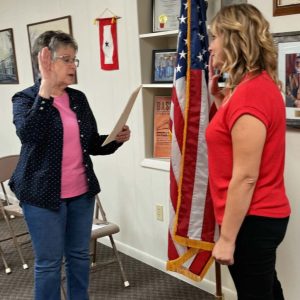
Crystal Murr officially assumed the duties of city clerk July 1 after spending several weeks training alongside Gibson.
Gibson said the city received several applicants for the position but quickly recognized Murr as the strongest candidate.
“We were very happy that it was Crystal,” Gibson said.
Murr said she looks forward to continuing the city’s work while using her experience in grant writing and community service to help move Edina forward.
She also acknowledged the challenge of following someone with more than five decades of institutional knowledge.
“After 54 years, there’s no way that she can tell me everything that she knows in two or three weeks,” Murr said.
Gibson said she was pleased the city selected someone local to continue the work. She said Murr’s background, willingness to learn and experience writing grants made her a strong choice to become Edina’s next city clerk.
Even after her official retirement, Gibson remained available to help with the transition through the end of the month and beyond if needed.
As she begins retirement, Gibson said she looks forward to traveling with her husband, Gary, volunteering with St. Joseph Catholic Church and the Knox County Historical Society, gardening, reading and spending more time with the couple’s three daughters and seven grandchildren.
The City of Edina recognized Gibson’s retirement with a fish fry luncheon hosted by the city’s work crew on Friday, June 26. Family members, friends, coworkers, city officials and community members also gathered Sunday, June 28, at the Knox County Community Center for a public retirement reception celebrating her 54 years of service.
During the reception, Gibson received official resolutions from the Missouri House of Representatives, presented by Rep. Greg Sharpe, and the Missouri Senate, presented on behalf of Sen. Cindy O’Laughlin by Lois Bragg.
She also received a Life Membership Certificate from the Missouri City Clerks and Finance Officers Association recognizing 43 years of membership and her induction into the organization’s Circle of Friends, along with a Certificate of Recognition from the association’s Northeast Division honoring her years of leadership and service.